
Choosing a diamond for a Marley turntable is less about finding “the best” and more about identifying the combination of parameters that are compatible with your setup. The type of cartridge mounting, the stylus profile, and the tracking force form a technical trio where each element influences the sound outcome. Comparing these variables helps to understand why two diamonds at the same price can produce very different results on the same turntable.
Mechanical Compatibility of Cartridges on a Marley Turntable
Competitors often elaborate on diamond shapes or MM/MC technologies but quickly overlook the point that deters most buyers: the mounting format. On House of Marley turntables, the cartridge is typically mounted in a standard half-inch format. This format allows for replacement with many market references, provided that the width between the two mounting screws is verified.
However, some entry-level turntables incorporate a non-removable proprietary cartridge. In this case, only the stylus (the playback tip) can be replaced, and the user does not have access to a true choice of cartridge. The distinction between these two situations is crucial: a half-inch mount opens up the field for upgrades, while an integrated mount limits options to replacement styli compatible with the original cartridge.
Before searching for a diamond, check whether your turntable allows for a complete cartridge change or only a stylus replacement. To delve deeper into the selection criteria and identify the suitable Marley turntable diamond for your model, the mounting type remains the first filter.

Stylus Profile and Sound Output: Comparison Table
The profile of the playback tip determines the contact surface with the vinyl groove, which directly influences frequency reproduction and record wear. Three profiles dominate the market for cartridges compatible with Marley turntables.
| Diamond Profile | Contact Surface | Treble Reproduction | Vinyl Wear | Price Positioning |
|---|---|---|---|---|
| Conical (spherical) | Pointed, wide | Average | More pronounced over time | Entry-level |
| Elliptical | Finer, biradial | Detailed | Moderate | Mid-range |
| MicroLinear / Shibata | Very fine, multi-contact | Very precise | Reduced | High-end |
A conical diamond is more forgiving of alignment defects in the arm. The elliptical profile offers the best compromise between precision and tolerance for the majority of belt-driven turntables, which includes the Marley models with belt drive.
Advanced profiles (MicroLinear, Shibata) require more rigorous azimuth and tracking force adjustments. On a turntable where the arm does not allow for micro-adjustments, the theoretical sound gain can be negated by approximate alignment.
Tracking Force and Arm Alignment: Adjustments That Change Everything
Audio improvement often comes more from correct adjustment than from a diamond change. A well-maintained diamond with precise alignment outperforms a new poorly adjusted diamond.
On Marley turntables equipped with an adjustable counterweight, three parameters deserve particular attention:
- The tracking force must match the range recommended by the cartridge manufacturer. A force that is too low causes skips, while excessive force accelerates groove and diamond wear.
- Anti-skating compensates for the natural tendency of the arm to drift towards the center of the record. An unbalanced adjustment generates asymmetric distortion between the left and right channels.
- The alignment of the cartridge in the headshell (overhang) is checked using an alignment template. A shift of a few millimeters is enough to alter the reading geometry and degrade sound quality.
These adjustments require no expensive tools. A printable template and a precision scale for the cartridge cover all needs.
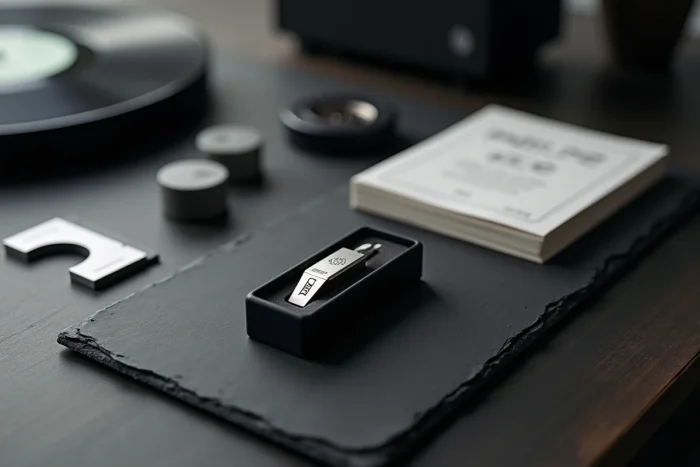
Diamond Wear on Vinyl Turntable: When to Replace the Stylus
The lifespan of a diamond depends on the profile, the applied tracking force, and the cleanliness of the records. Manufacturers and retailers emphasize that a replacement should be motivated by measured wear or audible symptoms, not merely by a desire for an upgrade.
Three signals indicate that a replacement is necessary:
- Progressive distortion on high-dynamic passages, especially at the end of the side.
- Excessive sibilance or hissing on vocals that was not present with the same record a few months earlier.
- A visual inspection of the tip (with a magnifying glass or pocket microscope) revealing a flat spot or asymmetry.
Replacing a diamond that is still in good condition with a model of the same profile does not yield any sound gain. Real improvement comes from a change in profile or cartridge technology, combined with the adjustments described above.
MM or MC Cartridge for a Marley Turntable
Marley turntables incorporate a phono preamplifier designed for moving magnet (MM) cartridges. Mounting a moving coil (MC) cartridge would require a compatible external preamplifier, which alters the audio chain and budget. For the majority of users, an MM cartridge with an elliptical diamond is the most coherent choice for this type of turntable.
Switching to an MC cartridge is justified in a dedicated hi-fi setup, with an amplifier that has an MC phono input or a separate preamplifier. On a Marley turntable used with its Bluetooth output or line connection, the investment in an MC exceeds what the rest of the chain can reproduce.
Ultimately, choosing a diamond for a Marley turntable comes down to three successive decisions: checking the mounting type, selecting a stylus profile suited to the arm’s precision, and then adjusting the tracking force according to the specifications of the chosen cartridge. These three steps, taken in this order, produce a more reliable result than any isolated model recommendation.