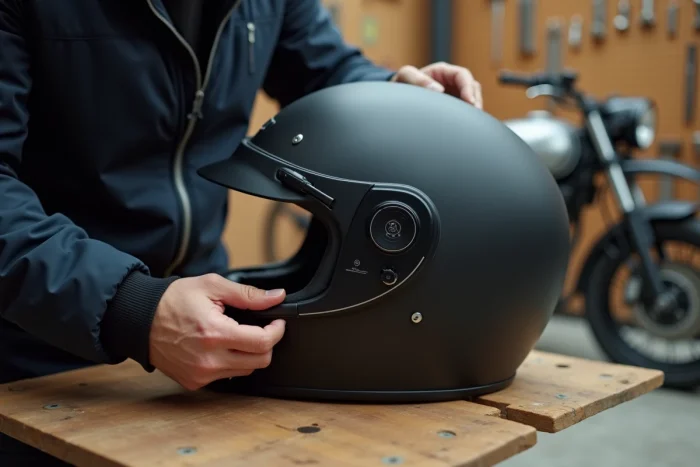
The positioning of the control module and the routing of the cables determine audio quality, the longevity of the installation, and comfort over long distances. Here we address the technical points that traditional tutorials skim over, particularly the disassembly of a poorly installed intercom and the choice of mounting mode based on the geometry of your helmet.
Removing a poorly installed intercom without damaging the helmet padding
An intercom attached with double-sided adhesive on the shell often leaves residues that tear the velvet or mesh fabric when pulled cold. We recommend heating the adhesive area with a hairdryer set to a warm position, about ten centimeters from the surface, for about thirty seconds. The heat softens the glue without deforming the polycarbonate or fiberglass shell.
Then, slide a plastic spatula (the one provided in most intercom kits) between the adhesive base and the shell. Move it with small lateral movements, never in vertical traction. A vertical motion risks delaminating the inner foam glued to the expanded polystyrene.
For persistent glue residues, a bit of isopropyl alcohol applied with a microfiber cloth is sufficient. Avoid acetone and chlorinated solvents, which attack varnishes and matte surfaces. If the padding is removable, take it out before any manipulation to work directly on the bare shell.
Regarding the speakers housed in the ear cavities, the wire that snakes under the lining is often held by small clips or adhesive pads. Peel each pad off individually rather than pulling on the cable: a wire torn at the transducer solder point turns the intercom into electronic waste.

For those who wish to delve deeper into the topic of optimal positioning, we recommend installing a motorcycle helmet intercom on My Little Car where the placement of each component is detailed according to the type of helmet.
Clamp or adhesive mounting: selection criteria based on the helmet
The majority of intercom kits offer two mounting modes for the main unit: a clip-on clamp for the base of the helmet and an adhesive plate glued to the shell. The choice between the two directly depends on the profile of the lower lip of your helmet.
- Metal or plastic clamp: suitable for full-face and modular helmets with a lip that measures at least a few millimeters thick. It allows for quick disassembly, transferring from one helmet to another, and does not alter the surface.
- Adhesive plate: recommended when the lip is too thin or absent (some jets, cross helmets with removable chin guards). Gluing provides a stable base but makes disassembly less easy.
- Hybrid mounting: some manufacturers provide an adapter that combines a spring clip and an adhesive reinforcement. This option is suitable for helmets whose geometry varies between sizes (the lip of an S does not always have the same thickness as that of an XL).
On a modular helmet like the BMW System 7 or Schuberth C5, the clamp is positioned on the left side, under the liftable chin guard. Placing the unit on the same side as the modular hinge creates a friction point that hinders the opening mechanism on some models. Check the available play with the chin guard raised before fixing anything.
Positioning of speakers and microphone on a full-face helmet
The speakers must be centered in front of the ear canal, not just placed at the bottom of the cavity. A shift of a few millimeters forward or backward degrades the reproduction of mid-tones and makes Bluetooth communications difficult to hear above 90 km/h.
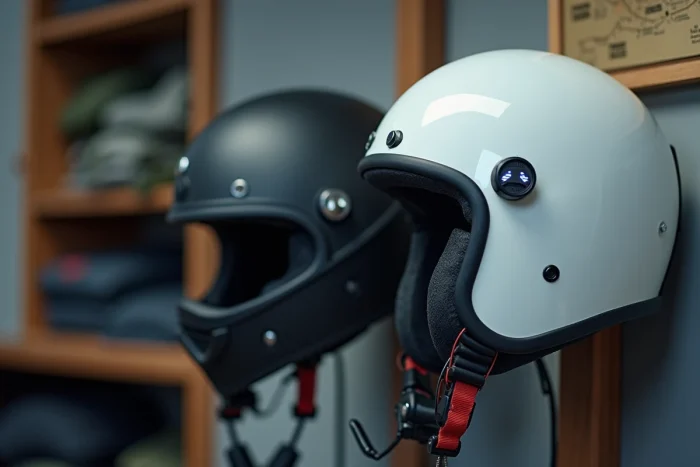
Most recent helmets integrate pre-milled slots to accommodate the speakers. If your helmet does not have them, use the foam spacers provided in the kit to adjust the depth. A speaker that touches the ear directly causes discomfort after half an hour and deforms the cheek pad.
Wired microphone or boom microphone: where to place for optimal capture
The boom microphone attaches inside the chin guard, oriented towards the mouth. On a full-face helmet, the distance between the mouth and the microphone remains constant, ensuring clear capture even at high speeds. The wired microphone with a pad, glued to the inner surface of the chin guard, is suitable for modular helmets where the boom might hinder lifting.
We observe that the main installation flaw concerns the routing of the microphone cable. The wire should run along the inner edge of the padding without passing in front of the wind flap. Poorly routed cables pick up vibrations from the chin guard and transmit a constant buzzing to your interlocutors.
Checks after installing the motorcycle intercom
Once the unit, speakers, and microphone are in place, replace the inner padding and close the helmet. Put it on and move your head from side to side, up and down. An unusual pressure point indicates a poorly routed cable or a misaligned speaker.
Initiate a Bluetooth pairing with your phone and make a test call. Ask your interlocutor to confirm the clarity of your voice. If the feedback mentions a hiss or metallic background noise, reposition the microphone by one or two millimeters and try again.
Also, check that the buttons on the unit remain accessible with thick winter gloves. Some perfect hand-only placements become unusable with touring gloves. Accessibility of the controls takes precedence over the aesthetics of the installation.
A final point often overlooked: the charging connector. Orient the USB or USB-C port downward or backward to avoid rainwater infiltration when the cover is open during charging. Installing your intercom following these technical guidelines ensures a clean, quiet, and durable installation over multiple seasons.