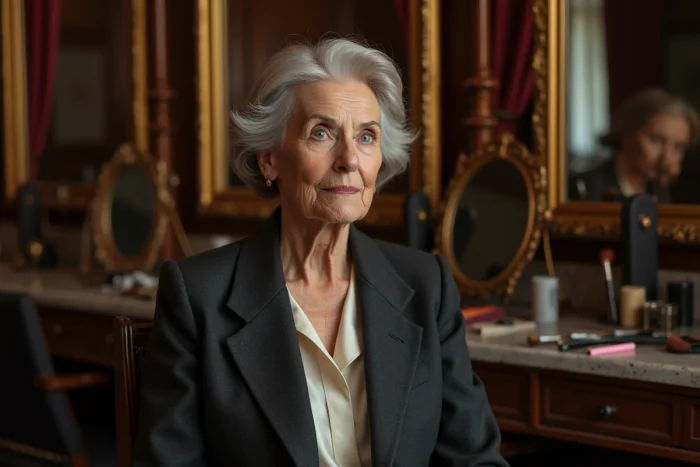
Marie-Christine Barrault, born on March 21, 1944, in the 8th arrondissement of Paris, belongs to a lineage where the relationship to text and stage is almost a genetic inheritance. The niece of Jean-Louis Barrault, she has built a career that spans over five decades of French cinema, from Rohmer’s auteur cinema to contemporary television productions, never confining herself to a single register.
Literary Training and the Development of an Intellectual Performance
Before stepping onto the stage, Marie-Christine Barrault pursued higher studies in literature. This academic background is not anecdotal: it has forged an intellectual relationship with dramatic text that distinguishes her from many actresses of her generation. Her reading of scripts involves literary analysis, an attention to narrative structure that directly informs her role choices.
This training also explains her ability to deliver dense texts, dialogues written to be thought as much as performed. In Éric Rohmer’s My Night at Maud’s (1969), she embodies Françoise with a restraint that stems as much from a philosophical understanding of the character as from her instinct as an actress. The film opens the doors to international recognition for her, with an Oscar nomination for Cousin, Cousine a few years later.
To delve deeper into the journey of actress Marie Christine Barrault, one can measure how much this dual culture, literary and dramatic, has shaped her entire filmography.
Filmography of Marie-Christine Barrault: Roles that Reveal a Method
We observe a constant in her career: the choice of female characters built on inner tension. No spectacular roles with effects, but women traversed by silent contradictions.
The Rohmer Turning Point and International Recognition
My Night at Maud’s remains the film that defines her place in French cinema. Rohmer entrusts her with an apparently secondary role, that of the young Catholic woman facing the male character played by Jean-Louis Trintignant. Yet, Françoise carries the moral resolution of the entire film. Rohmer’s direction, made up of long takes and almost philosophical dialogues, demands a performance of surgical precision.
Cousin, Cousine (1975) by Jean-Charles Tacchella offers her a completely different role. The film, lighter on the surface, relies on a romantic complicity that Barrault constructs with a precision that will charm American audiences to the point of generating a Hollywood remake.
Television Career and Diversification
Her filmography is not limited to auteur cinema. She has traversed several decades of French television with roles in series and TV films that have allowed her to reach a much broader audience. This ability to navigate between auteur cinema and television production demonstrates a adaptability in performance that many actors of her generation have not managed to negotiate.
Marie-Christine Barrault and Literary Transmission After Cinema
Marie-Christine Barrault’s career does not stop at the sets. For several years, she has engaged in an activity as an author and lecturer that extends her relationship with text. She participated in the 2023 Book Meetings in Noisy-le-Roi as an essayist, confirming a career extended well beyond just the filming sets.
This orientation is not a retreat. It contributes to a public reflection on the profession of actress. In the INA collection “Passé composé, figures du siècle,” recorded on February 1, 2024, she analyzes how the profession has changed over the decades. The interview, conducted by Annick Cojean, reveals an actress who thinks about her art with the rigor of an essayist.
- Lecturing activity focused on reading and literary transmission, with regular appearances at book festivals
- Publication of essays exploring the link between literary text and dramatic interpretation
- Participation in heritage interviews for INA, contributing to the memory of the acting profession in France
Private Life and Influence on Career Choices
Marie-Christine Barrault was married to Daniel Toscan du Plantier, a major producer in French cinema, and then to Roger Vadim, a director whose influence on French cinema in the 1960s and 1970s is well established. These two unions placed her at the center of the production networks of hexagonal cinema, but she has always maintained a distance between her marital life and her artistic choices.
After the passing of Roger Vadim, recent statements indicate that she chose not to “start her life” sentimentally, asserting that she did not wish to love again. This stance, far from being a withdrawal, seems to have liberated an energy directed towards transmission and writing.
A mother and grandmother to seven grandchildren, she now assumes a familial role that coexists with her artistic commitments. The nature of her recent projects, focused on speech and text rather than on sets, reflects a choice consistent with her intellectual journey.
Artistic Legacy of Marie-Christine Barrault in French Cinema
What strikes throughout this career is the coherence. From Rohmer’s performances to literary essays, Marie-Christine Barrault has never dissociated reflection and interpretation. In the INA interview of 2024, she emphasizes a form of inner necessity that has driven her towards the profession of actress, amplified by an artistic family environment.
Her journey offers a model of rare longevity in French cinema. The majority of actresses of her generation have seen their careers contract after fifty. Barrault has undergone a transformation towards cultural transmission that extends her public presence in a different but equally demanding form.
Her Oscar nomination, her collaborations with Rohmer and Tacchella, her marriages to Toscan du Plantier and Vadim outline a life where each step has nourished the next without a break in meaning. At 82, the actress remains an active voice in the French cultural landscape, driven by the same literary demand that guided her early role choices.