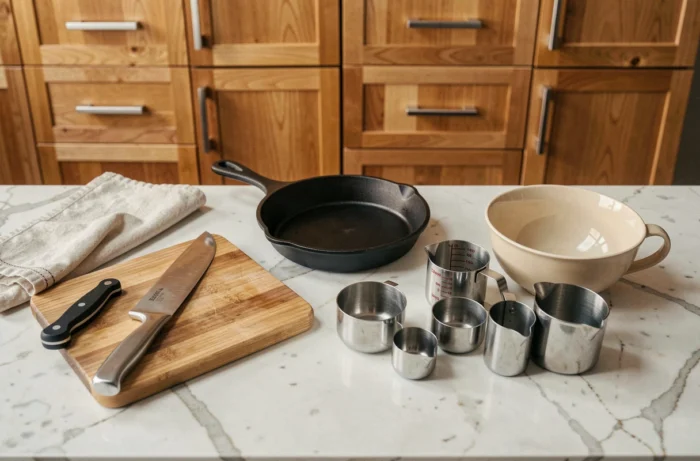
Equipping a kitchen is not just about stacking accessories in a drawer. The choice of equipment is based on criteria rarely addressed in traditional guides: sanitary compliance of materials, actual durability of coatings, and versatility for various recipes. Before making a list of kitchen utensils, one must understand what distinguishes reliable equipment from something that needs to be replaced in six months.
Materials for kitchen utensils: what regulations really require
All objects in contact with food fall under the European Regulation (EC) No. 1935/2004. Plastics are governed by an additional text, the EU Regulation No. 10/2011. When purchasing, the “glass and fork” pictogram on the packaging confirms suitability for food contact.
This point is not a marketing detail. The City of Paris classifies non-stick pans and certain utensils made from recycled plastic among potential sources of PFAS exposure. PTFE, used in most non-stick coatings, can degrade under high overheating. A scratched non-stick coating must be replaced, not simply ignored.
Stainless steel, cast iron, and carbon steel do not rely on a coating to function. Their longevity is incomparable to that of a low-end pan whose bottom deteriorates after a few months of daily use. To discover equipment on La Petite Casserole, the logic is the same: prioritize materials whose lifespan justifies the purchase price.
Regulations regarding bisphenol A have also evolved, making it necessary to check the compliance date of plastic containers, especially for storage boxes and spatulas used at high temperatures.

Chef’s knife and paring knife: the duo that covers most cutting tasks
Accumulating five or six different knives in a wooden block does not add value if two of them remain at the bottom of the drawer. In practice, a chef’s knife and a paring knife are sufficient for almost all domestic preparations.
The chef’s knife (medium-length blade, curved profile) handles cutting vegetables, meats, and slicing. The paring knife, shorter, takes over for precision tasks: peeling a fruit, removing a potato eye, cutting small items.
Blade maintenance: a often overlooked factor
A good knife poorly maintained cuts worse than an average knife that is regularly sharpened. Running it over a honing steel before each use significantly extends its sharpness. Washing in the dishwasher damages blades and handles, regardless of the material.
- Regular sharpening with a honing steel or stone, depending on the type of steel of the blade
- Hand washing and immediate drying to prevent oxidation
- Storing on a magnetic holder or in a case, never loose in a drawer where blades can collide
Frying pan, saucepan, and stockpot: three containers for cooking without multiplying equipment
Competitors of this article often segment cooking utensils into long lists. Field feedback varies on the ideal number of pieces, but three containers cover the vast majority of everyday recipes.
A versatile diameter frying pan (neither too small for two eggs nor too large for a standard heat) manages flat cooking: searing, browning, sautéing vegetables. A medium-sized saucepan is used for sauces, grains, and poached eggs. A stockpot or Dutch oven handles stews, soups, and long cooking.
The material of the frying pan deserves consideration. Enameled cast iron and carbon steel gain versatility over time (seasoning improves their natural non-stick properties). However, they require specific maintenance that not everyone is willing to undertake. The choice of material depends as much on cooking habits as on budget.
Precision tools in the kitchen: scale, thermometer, and mandoline
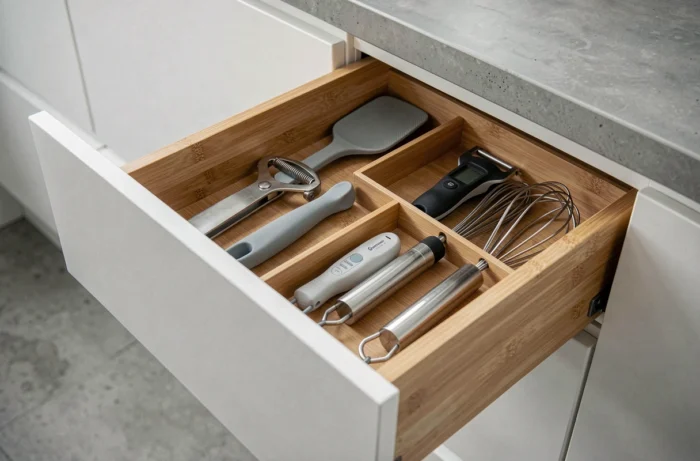
The success of a recipe often hinges on the precision of actions and measurements. Three tools bridge the gap between “approximately” and “just right”:
- The kitchen scale, ideally with a gram/milliliter toggle, eliminates guesswork in baking as well as in savory cooking
- The cooking thermometer allows checking the internal temperature of meat or caramel without repeatedly opening the oven
- The mandoline produces uniform slices of vegetables, improving even cooking and presentation of dishes
The mandoline remains a demanding tool in terms of safety. Always using the protective pusher prevents cuts, which are common among rushed users.
Durability and repairability of kitchen equipment
In France, the durability index began to replace the repairability index for certain categories of equipment in 2025. This index combines criteria of repairability and reliability. For now, manual kitchen utensils are not directly affected, but small kitchen appliances could integrate this system in the coming years.
The cost of spare parts and repairs remains a documented barrier at the European level. Before purchasing a food processor or blender, checking the availability of parts and the manufacturer’s repair policy is a reflex that prevents having to buy the entire device again after two years.
Good kitchen equipment is built gradually. Two well-sharpened knives, three cooking containers suitable for your usual recipes, and a few reliable measuring tools form a solid foundation. The rest will come with practice, as you prepare dishes that require more specific equipment.