
Between tall fescue, perennial ryegrass, and the so-called “C4” grasses, dryland mixtures are multiplying. Choosing a grass variety suitable for dry soil involves comparing specific criteria: rooting depth, water needs once the lawn is established, tolerance to foot traffic, and behavior according to soil type.
Grasses for Dry Land: Comparative Table of Common Species
Dry grass mixtures rely on a limited number of species. Their behavior varies significantly depending on the observed criterion.
| Species | Rooting | Drought Resistance | Foot Traffic Tolerance | Leaf Fineness |
|---|---|---|---|---|
| Tall fescue (Festuca arundinacea) | Deep | High | Good | Medium to coarse |
| Red creeping fescue (Festuca rubra) | Medium | Medium to good | Moderate | Fine |
| Kentucky bluegrass (Poa pratensis) | Medium (stolons) | Medium | Good | Medium |
| Perennial ryegrass (Lolium perenne) | Shallow | Low to medium | Very good | Medium |
| Hybrid Bermuda grass (C4, e.g., Cynodon) | Very deep | Very high | Very good | Fine |
Tall fescue dominates commercial mixtures for dry land due to a root system capable of reaching moisture deep in the ground. C4 grasses like Bermuda grass show even greater resistance, but they turn yellow in winter under temperate climates and are only suitable for regions with long, hot summers.
To identify the best grass for dry land on Jardindivert, it is useful to cross these characteristics with the nature of one’s own soil before ordering a mixture.
Tall Fescue vs. C4 Grasses: Where the Real Difference Lies
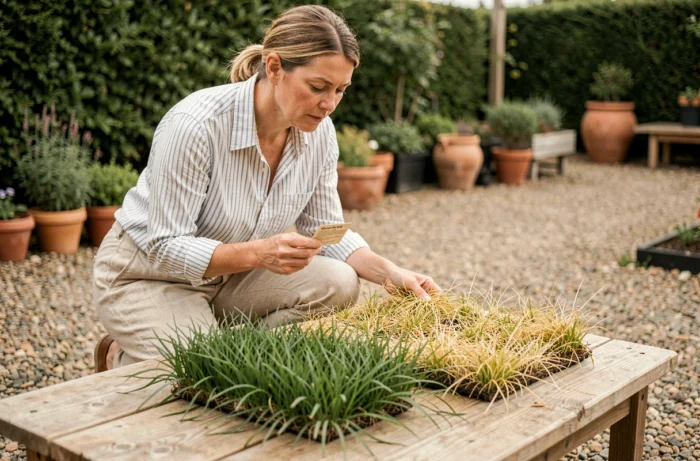
Tall fescue remains the basis of most bags sold in garden centers. It adapts to a wide range of soils, including the clay-limestone soils common in central and northern France. Its foliage, slightly wider than that of red fescues, gives it a less “English” appearance, but it compensates with a capacity to stay green for several weeks without water once well established.
C4 grasses (hybrid Bermuda grass, type Cynodon) function differently. Their photosynthetic metabolism allows them to drastically reduce their water consumption under extreme conditions.
Limitations to Know Before Choosing a C4
A C4 grass goes dormant when nighttime temperatures drop below a certain threshold. The lawn turns brown-yellow from November to March in the northern half of the country. This is not a sign of dying, but the aesthetic appearance displeases many homeowners.
The other point rarely emphasized: the establishment phase requires regular watering, regardless of the species. Even a very drought-tolerant Bermuda grass needs water to germinate and root. If watering restrictions are in place in the municipality at the time of sowing, the project may be compromised.
Watering Restrictions and Sowing Calendar: The Overlooked Criterion
Choosing a drought-resistant variety does not exempt one from checking local water usage rules. Prefectural restriction orders vary from one watershed to another and may prohibit any lawn watering, including for new sowing, as soon as the “enhanced alert” level is reached.
- Consulting the VigiEau platform allows one to know the applicable restriction level for their address before planning a sowing.
- A sowing at the end of summer or early autumn (September-October) reduces the risk of falling into full summer restrictions while benefiting from still warm soil.
- In a Mediterranean climate, an autumn sowing remains the most reliable window for both tall fescues and C4 grasses.
Sowing at the wrong time negates the advantage of a resistant variety. Drought tolerance only manifests once the root system is established, which takes several months.
Sandy, Calcareous, or Clayey Soil: Adapting the Mixture to Soil Texture
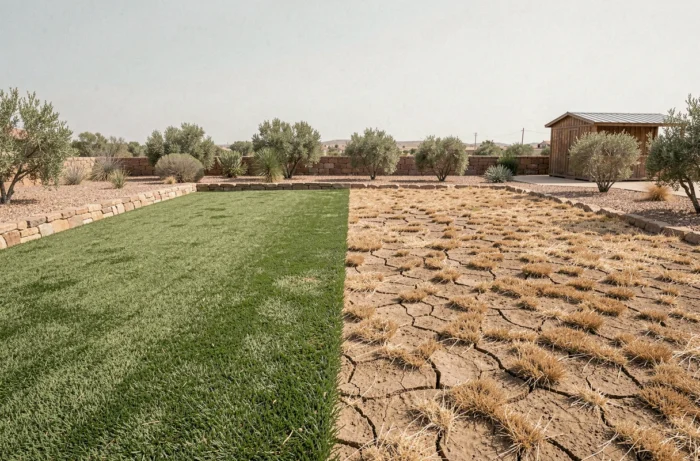
The drought resistance of a species also depends on the soil in which it grows. Sandy soil drains quickly and retains little water: tall fescue performs well there due to its deep roots, while perennial ryegrass, which is more superficial, suffers quickly.
On a calcareous soil, common in the southeast and the Paris basin, the high pH favors tall fescue and Kentucky bluegrass but limits certain varieties of red fescue that prefer neutral to acidic soils.
Mixture or Pure Species
Multi-species mixtures compensate for the weaknesses of each grass. A bag combining tall fescue (for drought resistance), red creeping fescue (for fineness), and a small proportion of perennial ryegrass (for rapid germination) covers most situations in temperate dry land.
Single-species seeds, particularly hybrid Bermuda grasses, are justified mainly in Mediterranean climates or in regions where summers regularly exceed long periods without rain. A diverse mixture offers more resilience than a single species in the face of climatic uncertainties from year to year.
Dwarf White Clover Overseeding: Alternative or Complement to Dry Grass
Dwarf white clover (Trifolium repens) is increasingly appearing in discussions about water-efficient lawns. A nitrogen fixer, it reduces the need for fertilizers and stays green longer than grasses during dry periods.
It can be overseeded into an existing lawn without tilling the soil, making it an interesting option to diversify a tired lawn. Its limitations are real: clover tolerates moderate foot traffic, not sports use. It also attracts pollinators, which can be problematic for families with young children walking barefoot.
The grass-clover association works better as a complement than as a total replacement. In dry land, integrating clover into low-traffic areas while maintaining a tall fescue-based lawn in frequently trafficked paths constitutes a balanced compromise between water efficiency and mechanical resistance.
Ultimately, the choice of a grass variety for dry land depends on three measurable variables: the nature of the soil, the climatic zone, and the expected level of foot traffic. Tall fescue remains the best compromise for the majority of French gardens in dry land, with C4 grasses taking over in the hottest areas of the country.